

Every March, small engine repair shops across the country face identical scenes: long queues of frustrated homeowners rolling in lawn mowers that refuse to start. In over 70% of those cases, the culprit isn’t a blown piston, broken belt, or dead coil—it is gummy, varnished fuel trapped in a tiny brass carburetor jet over the winter months.
⚠️ The Ethanol Reality: Modern E10 pump gasoline begins phase separating and oxidizing in as little as 30 days. Untreated fuel left in small 4-cycle engines draws ambient moisture through atmospheric vents, creating corrosive acidic deposits that corrode aluminum carburetor bowls and gum needle valves shut.
The Mechanics of Carburetor Gumming & Winter Degradation
Unlike modern automobiles with closed, pressurized fuel systems and computer-controlled electronic fuel injection, outdoor power equipment relies on atmospheric venting and gravity/float-fed carburetors. When your mower sits dormant in a freezing shed or unheated garage for four months:
- Ethanol Hydrophilic Absorption: Ethanol has an extreme chemical affinity for water. Temperature fluctuations cause condensation to form inside the plastic fuel tank, which the ethanol absorbs until it reaches saturation.
- Phase Separation: Once saturated, the ethanol-water mixture drops to the bottom of the fuel tank and carburetor bowl as a heavy, corrosive layer of acidic sludge.
- Fuel Evaporation & Lacquer Deposition: The light volatile hydrocarbons in gasoline evaporate, leaving behind heavy varnishes and sticky lacquers that clog microscopic pilot jets (often as small as 0.015 inches in diameter).
Taking 45 minutes in late autumn to execute a methodical winterization checklist guarantees that when the first warm weekend of April arrives, your mower fires up on the very first pull.
The 7-Step Definitive Winterization Protocol
Step 1: The Fuel Strategy — Stabilize & Run or Drain Dry?
Engine manufacturers have debated this for decades, but the consensus among small engine technicians is clear:
- The Preferred Method (Stabilize & Circulate): Fill your fuel tank 95% full with fresh gasoline treated with an antioxidant fuel stabilizer (e.g., Sta-Bil Storage or Sea Foam). Run the mower for 8 to 10 minutes under moderate load to ensure treated fuel circulates through the fuel line, fuel filter, float bowl, and carburetor orifices. A full tank leaves virtually no headspace for moist air to condense on tank walls.
- The Alternative Method (Total Drain): If storing in a basement or attached garage where local fire codes restrict gasoline storage, siphon the fuel tank dry, start the engine, and let it run until it sputters and stalls out from fuel starvation. Loosen the carburetor bowl drain screw to remove the final remaining teaspoon of gas.
Step 2: High-Temperature Oil Change
Never change mower oil cold. Run the engine for 5 minutes so the oil warms to operating temperature and suspends particulate debris. As motor oil lubricates during the mowing season, it absorbs acidic blow-by combustion gases, unburned fuel, and carbon. If left in the crankcase all winter, these acids slowly etch bearing surfaces and internal aluminum cylinder walls. Drain the warm oil, replace the filter (if equipped), and refill with the manufacturer-recommended viscosity (typically SAE 30 or 10W-30 synthetic).
Step 3: Spark Plug Removal & Cylinder Fogging
Disconnect the spark plug boot and remove the spark plug using a deep socket wrench. Inspect the electrode tip: a light tan or gray color indicates healthy combustion, while black sooty carbon points to an overly rich fuel mixture or clogged air filter. Spray 1 to 2 tablespoons of small-engine fogging oil (or clean 4-cycle motor oil) directly into the spark plug hole. Slowly pull the starter cord 2 to 3 times to distribute the protective oil film across the cylinder walls and piston rings. Install a fresh spark plug hand-tight plus a 1/4 turn, but leave the wire disconnected for safety.
Step 4: Undercarriage Scraping & Anti-Corrosion Treatment
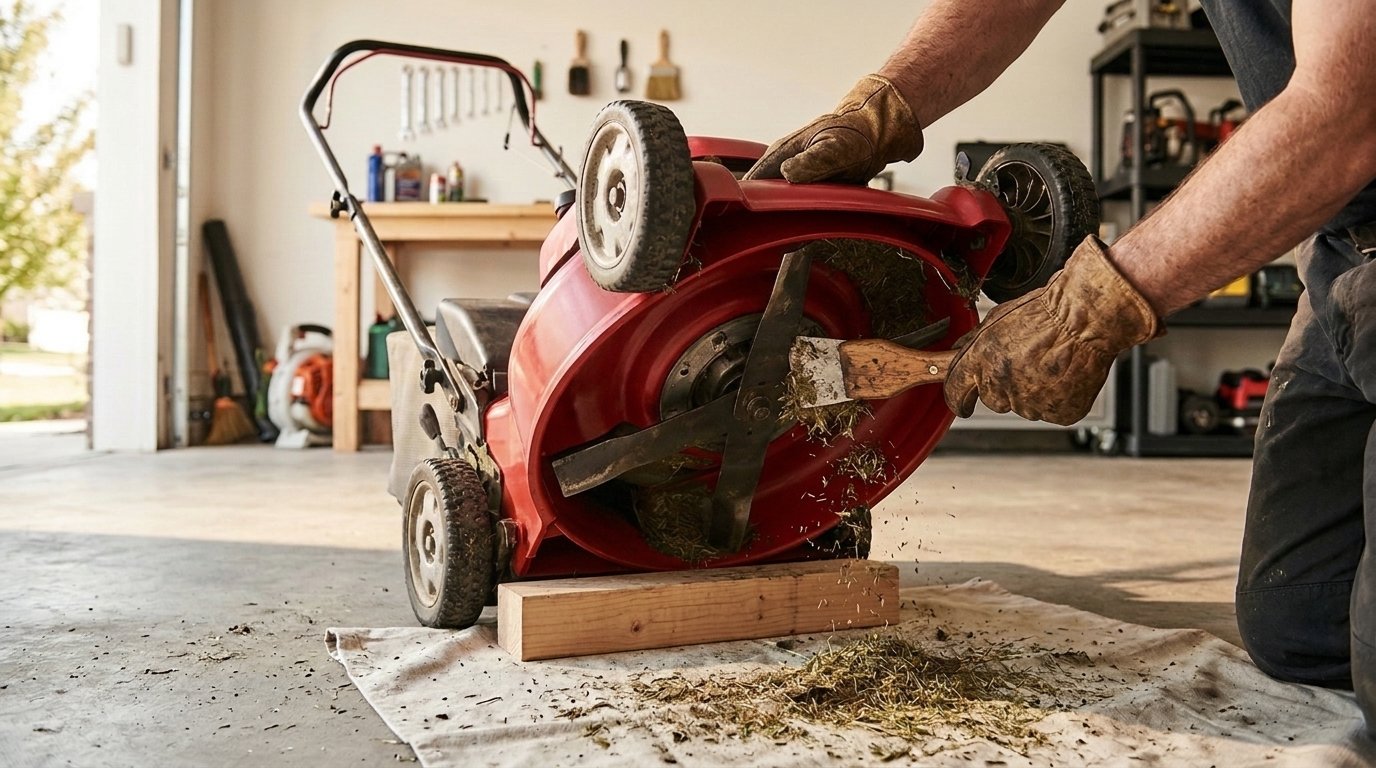
Tipping your mower incorrectly can flood the carburetor with oil or saturate the paper air filter. Always tip your mower with the air filter and carburetor pointing straight UP (spark plug toward the ceiling or fuel tank toward the ground). Use a wooden or plastic putty knife to scrape caked, fermenting grass clippings from underneath the steel mowing deck. Decaying grass clippings release moisture and organic acids that can corrode through 14-gauge steel decks in just a few seasons. Once clean and dry, spray the bare steel with a lanolin-based rust inhibitor (like Fluid Film) or silicone spray.
Step 5: Blade Inspection, Sharpening & Balancing
Remove the mower blade retaining bolt while wearing heavy leather gloves (block the blade rotation with a 2×4 block of wood against the deck). Inspect the cutting edge for nicks and gouges from hidden rocks or roots. Sharpen the blade maintaining a clean 30-degree bevel angle using a metal file or bench grinder. Crucially, balance the blade on a conical wall-mounted balancer or a nail through the center hole. An unbalanced blade spins at 3,000 RPM, creating severe high-frequency vibrations that destroy crankshaft bearings and engine seals. Wipe the sharpened edge with mineral oil to prevent winter surface rust.
Step 6: Air Filter Cleansing & Detritus Extraction
Unlatch the air filter cover. If you have a pleated paper filter, tap it gently against a flat surface to dislodge loose dust; if oil-stained or darkened, discard and replace it. If your mower uses a foam pre-filter, wash it with warm water and mild liquid dish soap, allow it to dry completely, and apply 5 drops of clean motor oil, squeezing out any excess. Use compressed air or a soft brush to clear grass debris from the engine cooling fins around the cylinder head. Rodents frequently nest in cooling fins over the winter, leading to catastrophic overheating upon spring startup.
Step 7: Battery Maintenance & Off-Season Storage
For electric-start gas mowers or battery-powered electric models, remove the battery. Never leave a lead-acid or lithium battery sitting in sub-zero shed conditions on bare concrete. Store the battery in a dry, climate-controlled space (between 50°F and 70°F) on a wooden shelf. For 12V lead-acid batteries, connect a microprocessor-controlled smart trickle charger to maintain float voltage at 13.2V to 13.6V. For lithium-ion packs, store them at roughly 50% state of charge rather than 100% full to prevent cathode degradation.

Spring Startup Diagnostics Matrix
Even with diligent care, issues occasionally arise after long storage. Use this diagnostic table to troubleshoot spring startup issues in minutes:
Elevating Your Turf Strategy with Good Neighbor Crew
Equipment maintenance is only one half of a thriving, resilient home lawn. Once your mower is safely prepped for the winter freeze, focus your efforts on soil health and seasonal nutrition.
For a complete, month-by-month roadmap on soil amendments, proper mowing heights, and weed prevention schedules, download The Complete Good Neighbor Lawn Care Guidebook.
Before putting your equipment away for good, make sure your turf has received its vital late-fall nutrients. Be sure to calibrate your broadcast spreader carefully in half-rate crisscross passes to avoid fertilizer burn and striped turf, and check our final mowing height before winter guide before storing your deck. If your yard still has a heavy blanket of autumn foliage, learn how Mulching Leaves into Turf Builds Soil Organic Matter instead of bagging and hauling valuable nutrients to the landfill.
Achieve Deep Green Turf Every Spring
Equip yourself with practical, science-backed turf protocols written by neighborhood lawn care experts.
Frequently Asked Questions (FAQ)
How long can stabilized fuel safely remain in a lawn mower?
Quality fuel stabilizers prevent oxidation and chemical breakdown for up to 12 to 24 months, depending on the brand formula. However, for best seasonal performance, treat fresh gasoline in November and consume it within the first 60 days of spring mowing.
Can I use car motor oil in my 4-cycle lawn mower?
While modern automotive oil meets basic lubrication standards, air-cooled lawn mower engines run significantly hotter (up to 280°F cylinder temps) than water-cooled cars. Use heavy-duty small engine oil with zinc/phosphorus anti-wear additives (SAE 30 or full synthetic 10W-30) that resists thermal shear.
What happens if I tip my mower the wrong way?
Tipping with the air filter downward allows crankcase oil to drain through the breather tube directly into the carburetor and air filter element. This ruins paper filters, produces blinding white smoke upon startup, and can cause hydro-lock. Always tip with the air filter pointing toward the sky.
Should I remove the mower blade completely for winter storage?
Removing the blade completely is recommended if storing the mower in an unheated shed prone to humidity. This allows you to bring the sharpened, balanced blade into a dry workshop or basement, wiping it with oil to prevent pitting along the newly sharpened edge.
Do electric / battery mowers need winterization?
Yes, though simpler. Clean the deck undercarriage, sharpen the blade, and clear motor housing cooling vents. Crucially, remove the lithium-ion battery pack and store it indoors at 50% charge. Freezing temperatures permanently diminish lithium cell capacity and cause internal resistance buildup.
How can I tell if my carburetor already has gum or varnish?
A mower that only runs while the choke is engaged or constantly surges and sputters under load has a gummed main or pilot jet. The restricted orifice starves the combustion chamber of fuel, forcing the governor to hunt back and forth to keep the engine from stalling.
Published by Good Neighbor Crew • Tested turf management protocols for serious homeowners and lawn care enthusiasts. Have questions or need equipment recommendations? Explore our resource library.