
QUICK ANSWER // WHAT DO LAWN FERTILIZER NUMBERS MEAN?
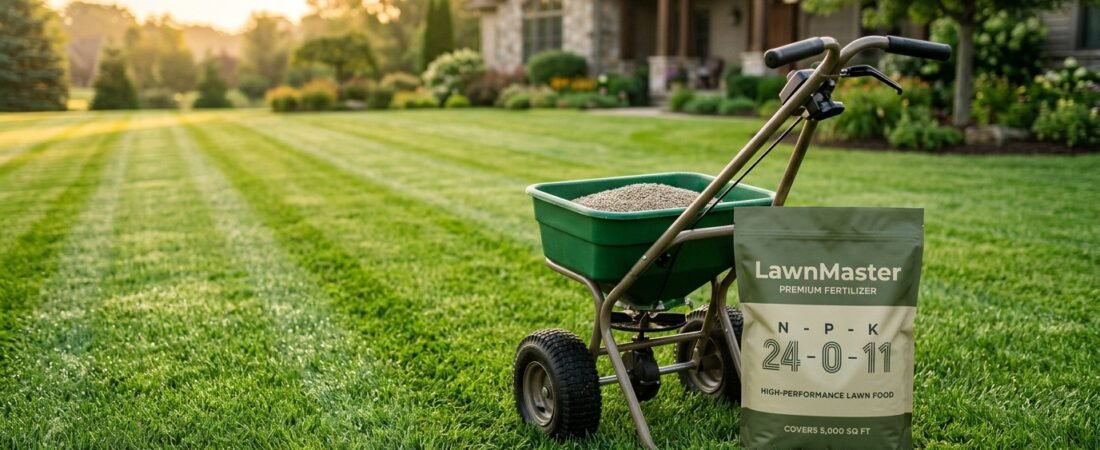
The three numbers on a fertilizer bag represent the guaranteed percentage by weight of Nitrogen (N), Phosphate (P₂O₅), and Potash (K₂O), always displayed in that exact order (N-P-K). For example, a 50 lb bag of 24-0-11 contains 24% actual nitrogen (12 lbs), 0% phosphorus, and 11% potassium (5.5 lbs). The remaining 65% consists of inert carrier granules and secondary micronutrients designed for even spreader calibration.
Walking down the lawn care aisle at your local garden center can feel overwhelming. Towering pallets of fertilizer bags boast cryptic numerical formulas like 32-0-4, 10-10-10, 24-0-11, and 16-4-8. Many homeowners purchase whatever bag features the brightest picture of turf on the label, only to end up scorching their lawn or fueling an uncontrollable outbreak of brown patch fungus. Decoding fertilizer math is the single most valuable skill in residential turf management, protecting both your lawn’s root health and your seasonal maintenance budget.
1. The Biological Role of the Primary Macronutrients
Turfgrass requires sixteen essential elemental nutrients to survive, but it consumes three in massive volumes relative to the rest. These three macro-elements constitute the universal N-P-K labeling standard mandated by agricultural regulatory bodies:
- Nitrogen (N) — The Growth & Color Engine: Nitrogen is the core building block of plant amino acids and chlorophyll molecules. It powers vegetative shoot extension, horizontal stolon/rhizome creep, and that deep emerald hue every homeowner strives for. However, excessive fast-release nitrogen forces excessive top-growth at the expense of root mass, creating soft, succulent tissue that attracts fungal pathogens.
- Phosphorus (P) — The Root & Cellular Anchor: Phosphorus drives adenosine triphosphate (ATP) energy transfer within grass cells. It is paramount during seed germination, sod establishment, and spring sprigging. Most mature residential lawns have adequate soil phosphorus reserves; in fact, many state environmental regulations prohibit phosphorus application on established turf unless an official soil test proves a deficiency, preventing lake and groundwater algae blooms.
- Potassium (K) — The Cellular Armor: Potassium regulates stomatal aperture (moisture transpiration through blade pores) and thickens plant cell walls. While nitrogen dictates how green the lawn looks, potassium dictates whether the grass survives a blistering July heatwave, heavy backyard foot traffic, or sub-freezing winter ground temperatures.
2. How to Calculate Actual Nitrogen Per 1,000 Square Feet
Agronomists and university turf extensions express fertilizer recommendations in pounds of actual nitrogen per 1,000 square feet (typically 0.75 to 1.0 lb N per application). Never assume a 40 lb bag covers the square footage claimed on the front without verifying the math:
The Nitrogen Math Formula:
Bag Weight × (Nitrogen % ÷ 100) = Total Pounds of Actual Nitrogen in Bag
Desired Rate (1.0 lb) ÷ (Nitrogen % ÷ 100) = Pounds of Fertilizer Product Needed per 1,000 sq ft
Example: For a 50 lb bag of 24-0-11: 50 × 0.24 = 12 lbs of actual N. To apply 1.0 lb of N per 1,000 sq ft, you need 1.0 ÷ 0.24 = 4.16 lbs of product per 1,000 sq ft. A 5,000 sq ft lawn requires approximately 20.8 lbs of fertilizer.
3. Recommended N-P-K Ratios by Turfgrass Species
Different grass varieties have vastly different metabolic rates and seasonal growth curves. Applying a high-nitrogen spring fertilizer to a dormant warm-season grass will simply feed emerging summer weeds while wasting fertilizer:
| Turfgrass Variety | Ideal Target Ratio | Spring Feeding | Fall Winterizer | Annual N Cap (lbs/1k) |
|---|---|---|---|---|
| Bermuda Grass | 4-1-2 / 3-0-1 |
Late Spring (After 100% Greenup) | High Potassium (10-0-20) | 3.0 – 5.0 lbs |
| St. Augustine Grass | 3-1-2 / 4-0-2 |
Mid-Spring (Moderate N) | Potassium-Rich Blend | 2.0 – 4.0 lbs |
| Zoysia Grass | 1-0-1 / 2-0-1 |
Late Spring (Low N) | Zero N / High K | 1.5 – 3.0 lbs |
| Tall Fescue (Cool Season) | 4-0-1 / 3-1-2 |
Light Spring Touch-Up | Heavy Fall Feeding (Sept–Nov) | 2.5 – 4.0 lbs |
| Kentucky Bluegrass | 4-1-2 / 3-0-2 |
Moderate Spring App | Heavy Late Fall Application | 3.0 – 4.5 lbs |
4. Fast-Release vs. Slow-Release Nitrogen Delivery
Looking beyond the N-P-K percentage, examine the guaranteed analysis on the back of the bag for Slow-Release Nitrogen (SRN) or Water Insoluble Nitrogen (WIN):
- Quick-Release (Urea, Ammonium Sulfate): Completely water-soluble. Delivers an immediate surge of vibrant green within 48 to 72 hours. However, it lasts only 2 to 3 weeks, carries a high salt index that risks burning the lawn under heat, and leaches rapidly through sandy subsoils.
- Slow-Release (Polymer-Coated Urea, Methylene Urea): Granules are coated in sulfur or synthetic polymers that break down gradually via soil moisture and microbial activity. They feed grass steadily over 8 to 12 weeks, prevent surge growth, and eliminate chemical burn hazards. Look for bags containing at least 30% to 50% slow-release nitrogen for residential maintenance.
The Golden Rule: Test Soil Before You Guess
Before spending hundreds of dollars on specialized fertilizers, submit a simple soil sample to your state university extension office (typically $15–$25). If your soil pH is 5.2 (highly acidic) or 8.0 (alkaline), the roots cannot absorb nitrogen regardless of how much fertilizer you spread. Balancing soil pH with agricultural lime or elemental sulfur unlocks existing nutrients naturally.
Explore Related Lawn Maintenance Guides:
- Warm-season grass selection: Bermuda vs St. Augustine vs Zoysia Comparison
- Stop weeds before germination: Spring Pre-Emergent Timing & 55°F Soil Benchmark
- Eradicate breakthrough weeds: How to Kill Crabgrass Without Damaging Southern Turf
Frequently Asked Questions (FAQ)
What do zero numbers in fertilizer mean (e.g. 24-0-11)?
A middle zero indicates that the fertilizer contains 0% phosphorus. Zero-phosphorus blends are standard for mature established lawns because excessive phosphorus causes toxic environmental runoff into local waterways and lakes.
Can I use a 10-10-10 fertilizer on my lawn?
A 10-10-10 blend is an all-purpose garden fertilizer, not an ideal lawn formulation. Established turf needs much more nitrogen than phosphorus. Applying 10-10-10 repeatedly will overload your soil with unnecessary phosphorus while underfeeding the nitrogen needs of the grass.
When is the best time of day to apply fertilizer?
The ideal window is early morning or late afternoon when the grass blades are dry and temperatures are mild. Never apply synthetic fertilizer to damp blades under direct midday sun, as the granules will stick to the leaves and cause severe chemical leaf burn. Always water the lawn lightly after application to wash granules off the foliage into the soil zone.