
Few sights are more frustrating to a dedicated homeowner or neighborhood volunteer than stepping onto what should be a lush, uniform green turf, only to discover aggressive crabgrass tillers, stubborn creeping clover, and tough taproot dandelions choking out desirable grass. If you missed the early spring pre-emergent herbicide barrier window—or if breakthrough occurred along concrete walkways and driveway edges—you cannot simply spray non-selective weed killers like glyphosate without wiping out your entire lawn. In 2026, conquering an active weed infestation requires understanding selective post-emergent chemistry: targeting invasive vascular weeds at the root level while preserving every blade of your Kentucky Bluegrass, Tall Fescue, or Bermudagrass.
1. Selective vs Non-Selective Herbicides: The Chemistry of Weed Eradication
The fundamental rule of lawn recovery is matching the right selective chemical compound to your exact weed species and grass cultivar. Non-selective herbicides kill all green plant tissue indiscriminately. In contrast, selective post-emergents exploit hormonal, photosynthetic, and enzymatic differences between monocot turfgrasses and target weed families.
| Active Ingredient | Target Weed Spectrum | Safe Turfgrass Varieties | Surfactant Needed? |
|---|---|---|---|
| Quinclorac (Drive XLR8) | Large & Smooth Crabgrass, Foxtail, Torpedograss, Clover | KBG, Tall Fescue, Rye, Bermudagrass, Zoysia | Yes (Methylated Seed Oil – MSO) |
| 2,4-D + Dicamba + MCPP (3-Way Mix) | Dandelions, Plantain, Chickweed, Thistle, Broadleaf weeds | Most Cool-Season & Established Warm-Season | Yes (Non-Ionic Surfactant – NIS) |
| Triclopyr (Turflon Ester) | Creeping Charlie (Ground Ivy), Wild Violet, Oxalis | Cool-Season Turf Only (Berms/Zoysia will burn) | Yes (Non-Ionic Surfactant) |
| Halosulfuron-methyl (SedgeHammer) | Yellow & Purple Nutsedge, Kyllinga | Safe on virtually ALL cool and warm-season grasses | Yes (Included in packet or NIS) |
2. The Strict 85°F (29°C) Temperature Cutoff Rule
The number one reason DIY homeowners accidentally kill their lawn while attempting to eradicate crabgrass is spraying during mid-summer heatwaves. Post-emergent herbicide chemical labels strictly state: Do not apply when ambient temperatures exceed 85°F (29°C).
Why Heat Causes Severe Turf Phytotoxicity:
When grass leaves are hot and dry, herbicide carrier solvents evaporate almost instantaneously, concentrating chemical salts on the leaf surface. This causes severe chemical burn, cellular desiccation, and permanent root damage. Always spray in the early morning (between 6:30 AM and 8:30 AM) when dew has evaporated, temperatures are below 75°F, and wind velocity is under 5 mph to eliminate drift.

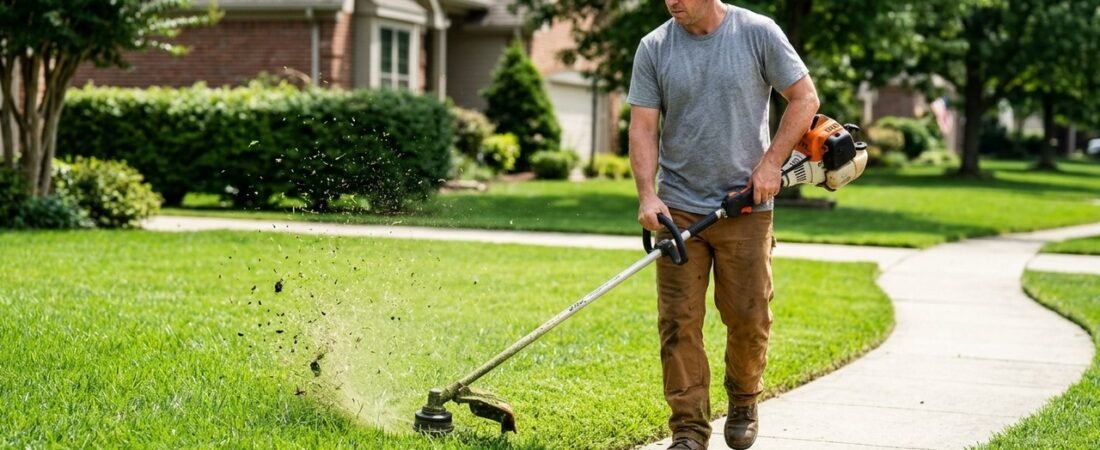
Good Neighbor Crew volunteers partnering with elderly neighbors to restore neglected, weed-invaded turf.
3. Sprayer Calibration Math & Surfactant Mixing Ratios
Broadcasting weed killer across an entire lawn is rarely necessary and increases chemical runoff. Instead, utilize a dedicated 1-gallon or 2-gallon handheld pump sprayer with an adjustable fan nozzle for precision spot-treatment.
- Water Volume: Fill your tank with 1 gallon of clean water (covers approx. 1,000 sq ft of target weed area).
- Active Herbicide: Add manufacturer-recommended concentrate (typically 1.45 fl oz of Quinclorac or 1.5 fl oz of 3-way broadleaf mix per gallon).
- Methylated Seed Oil (MSO): Add 2 teaspoons (0.33 fl oz) of high-grade MSO or NIS. This breaks water surface tension and dissolves the weed’s waxy cuticle layer, allowing systemic translocation to the root within 6 hours.
- Blue Spray Indicator Dye: Add 0.5 teaspoon of temporary non-staining blue turf dye. This visibly shows exactly which weed clumps have been coated, preventing double-spraying and wasted chemicals.
4. Long-Term Weed Prevention: The Natural Turf Defense
Herbicides are a temporary reset button, not a permanent cure. Weeds only germinate where soil is exposed, sunlight reaches bare dirt, and grass roots are shallow. To eliminate weeds permanently:
- Mow at 3.5 to 4 Inches: Taller grass blades cast deep shadows on the soil surface, naturally starving weed seeds of the sunlight they need to germinate.
- Core Aerate Annually: Relieve soil compaction so grass roots can penetrate 6 to 8 inches deep into moisture reserves. Review our detailed Core Aeration vs Liquid Aeration Guide for decompaction timing.
- Overseed in Autumn: Fill bare spots with dense turf varieties before weeds can establish root systems. Follow our Lawn Overseeding Blueprint.
Know an Elderly Neighbor Whose Lawn Needs Help?
The Good Neighbor Crew is a 100% free volunteer community organization. We mow, edge, weed, and restore yards for senior citizens, disabled veterans, and struggling families—always for $0.00.
Related Seasonal Lawn Restoration Guides:
- Prevent weeds early: Pre-Emergent Herbicide Soil Temperature Timing Guide
- Soil compaction relief: Core Aeration vs Liquid Aeration Breakdown
- Fill thin patches: How to Overseed a Thin Lawn Complete Step-by-Step
Know a Neighbor Who Needs a Helping Hand?
Good Neighbor Crew is dedicated to providing 100% free lawn mowing, edging, and yard restoration for elderly seniors, disabled veterans, and struggling single parents. We never charge a dime—this is our grassroots way of keeping neighborhoods dignified and safe.