
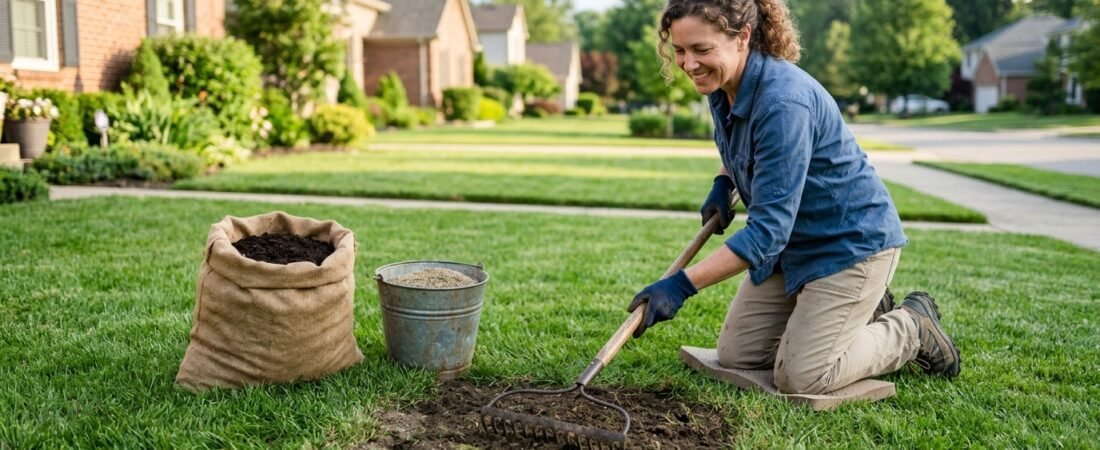
To loosen rock-hard compacted clay soil on a budget without renting a 300-pound mechanical aerator or destroying your yard with a rototiller, follow this proven 3-step biological remedy: spot-perforate high-traffic zones with a manual core aerator fork, spray a liquid soil conditioner (humic acid + yucca surfactant) to open microscopic soil pore space, and topdress with a 1/4-inch layer of rich organic compost.
Heavy clay consists of microscopic, flat platelet particles that bond tightly together like stacked playing cards, squeezing out oxygen and forcing water to pool or run off. Adding organic matter and non-ionic soil surfactants encourages earthworms and beneficial soil biology to loosen these bonds naturally over 6 to 12 weeks.
At-a-Glance: Clay Soil Loosening Methods Compared
| Method | Budget Cost | Physical Effort | Speed of Results | Best Time of Year |
|---|---|---|---|---|
| Liquid Soil Conditioner | $15 – $30 | Very Low (Sprayer) | 2 to 4 weeks | Spring, Summer, Early Fall |
| Manual Core Fork | $25 (Tool purchase) | Moderate (Step & Press) | Immediate physical holes | Fall or Spring (Damp soil) |
| Compost Topdressing | $30 – $60 bulk | Moderate (Raking) | 6 to 12 weeks (Permanent) | Early Fall or Mid Spring |
| Rented Motorized Aerator | $90 – $150 / day | Heavy (requires truck ramp) | Immediate physical cores | Fall primary season |
The #1 Mistake: Never Add Sand to Clay Soil!
A widespread gardening myth suggests mixing playground or masonry sand into clay soil will “lighten it up.” This is a catastrophic error. Mixing sand particles into fine clay platelets creates natural brick mortar. Instead of improving drainage, your soil will cure into solid concrete under the summer sun, permanently suffocating grass roots. The only substance that permanently loosens clay soil structure is decomposed organic matter (compost, humic acids, and shredded leaves).
Build Healthy, Rich Soil That Grows Turf on Autopilot
Healthy grass starts 6 inches below ground. Our complete handbook “Good Lawns Don’t Happen by Accident” breaks down DIY soil testing, organic amendments, and seasonal aeration routines without expensive commercial contractors.
The 3-Step Budget Blueprint for Soft, Loamy Soil
Step 1: Test Compaction with the 6-Inch Screwdriver Test
Push an ordinary 6-inch flathead screwdriver straight down into your lawn:
- If you can easily push it 5 to 6 inches deep, soil porosity is adequate.
- If the shaft stops abruptly at 1 or 2 inches, your lawn is severely compacted. Roots cannot breathe, water cannot infiltrate, and fertilizer remains trapped on the surface.
Step 2: Apply a Liquid Soil Aerator Spray
Commercial liquid aerators contain yucca extract, non-ionic surfactants, and liquid humic acid. These organic compounds reduce the electrostatic tension holding clay platelets together, allowing irrigation water to penetrate up to 3x deeper into hardpan soil. Spray using a standard hose-end sprayer, then water your lawn deeply with 0.5 inches of water immediately afterward.
Step 3: Topdress With 1/4 Inch of Fine Screened Compost
After liquid conditioning or using a manual step-core tool, scatter 1/4 inch of screened organic compost or worm castings across the surface. Use the backside of a garden rake to gently work the compost into the grass canopy down to the soil line. Earthworms feast on this surface carbon and tunnel down through the clay, depositing rich worm castings and creating thousands of microscopic drainage channels.
Frequently Asked Questions (FAQ)
Does liquid aeration really work on heavy clay?
Yes. While liquid aeration does not physically pull dirt plugs out like a heavy gas aerator, it uses bio-surfactants and humic acids to break the surface tension of clay particles, allowing moisture and root tips to penetrate deeper into compacted soil layers.
Does gypsum loosen clay soil?
Only if your soil has high sodium (salt) levels. In sodic clay soils common in coastal or arid western regions, calcium in gypsum replaces sodium and flocculates (clumps) clay particles. In normal non-sodic clay soils, gypsum has little to no loosening effect; organic compost is far more effective.
How often should you aerate clay soil?
Clay soils in high-traffic suburban lawns should be aerated at least once per year (ideally in early fall for cool-season turf, or late spring for warm-season turf). Once soil biological health is restored with compost topdressing, aeration can be reduced to once every two years.